Centrist Ex Nihilo?
The challenge of more than just thinking a centrist party in a small democracy...

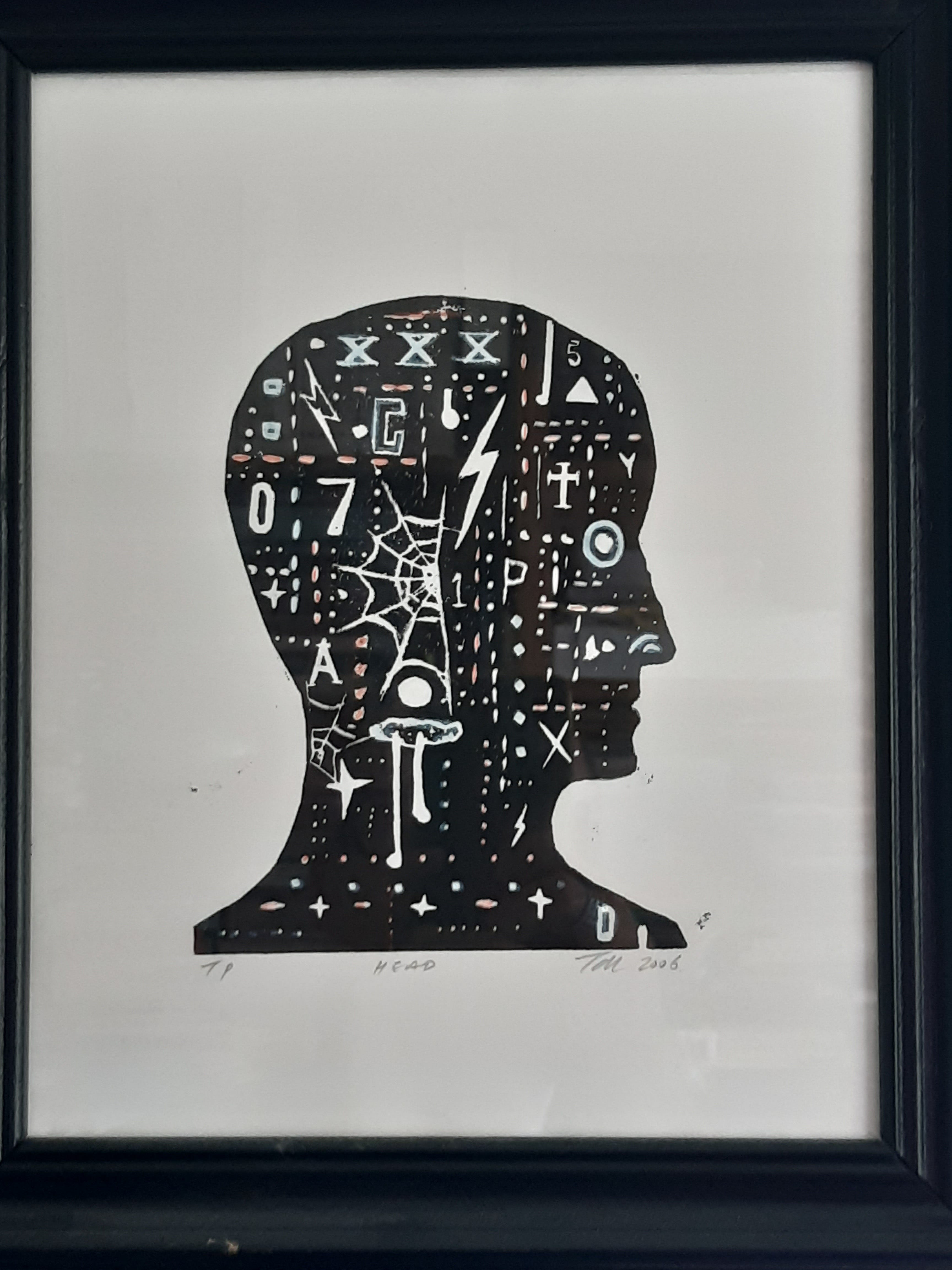
Tony de Lautour’s Trial Proof of his “Head” hangs on my office wall as both a reminder and articulation of the issue getting all that occurs within your head out into coherent expression and representation. Ideas have a pre-life but which means somewhere to come from and be related to; but they also need to able to be understood and engaged with by more than just the person putting them forward.
I’ve been thinking about this in relation to the question of whether a centrist party is possible in New Zealand politics; a question, idea and suggestion that makes an occasional appearance from various voices because of an on-going (and often widespread) disaffection with the oppositional nature of our political system that seems to limit change,
Over about 18 months I was one of a number of people Paul Kennedy Gunson bounced ideas off as a new centrist political party was planned and developed, one which sadly went into suspension over the summer due to insufficient benefactor support. It was interesting to be part of this, even in a small, non-member way as it helped me refine some thinking about the issues of party politics in a small democracy and what I might term the societal inhibitors of any such new venture. It’s also very useful to have access to a Q&A Gunson undertook with a couple of independent commentators as such self-reflexive honesty is all too rare in our political system. [Gunson has very kindly allowed me to make use of it for this discussion]
The aim of the proposed new party was “to improve the public trust in politicians” [some might say that was in itself the central challenge to success] by not only “diluting the influence of special interests” but also by improving “the right kind of political discourse”.
Yet all our existing and successful political parties have arisen from and still include and represent ‘special interests’; it’s what gives them their history and their identity and their influence. We could say special interests provide their ontology, their nature of being. This ontology, this collection of ‘special interests’ waxes and wanes and changes over time, sometimes a core facet can be lost or discarded or beguiled away by another party ( i.e. the conservative working class to National under Muldoon) while new special interests arise and rise (or fall) through internal politics and infighting and dominance. Parties can also form out of alliances that become an ongoing set of internal, often competing special interests such as the birth of the National party in 1936 our of the conservative Reform and liberal United parties.
But what and who, we need to ask, are the ‘special interests’ of any centrist party that is not a coming together of existing members and importantly, MPs of oppositional parties and blocs? How many remember the brief centrist spurt of Clive Matthewson’s United NZ party [https://en.wikipedia.org/wiki/United_New_Zealand] that in 1995 brought together 6 MPs but failed to survive the 1996 election? That one-man centrist party Peter Dunne was the only one of the six to survive by being able to draw on his existing, well-established right-wing Labour roots and find an accommodation not only with his electorate voters but with both Labour and National-led governments. We could say his ‘special interests’ were the voters of what was variously Ohariu, Ohariu-Belmont, Onslow and then again Ohariu ( the later name also going through a variety of spellings).
But these centrist MPs came from somewhere, they didn’t arise out of nothing’; so I wonder if it is all but impossible for any new Centrist party to arise unless it forms out of existing ones and MPs? And even then it seem it is very difficult, if not impossible to survive. That is, how do you make a centrist idea a new reality?
As Gunson notes, ‘special interests’ both represent and attract donors and political parties can’t arise and exist and succeed without such donors… which in retrospect puts an anti-special interest stance as a fatal flaw.
A second challenge the proposed Foward party faced was a decision to be “anti-special interests without being anti-establishment”. Yet I’d suggest both Labour and National are not only centrally-based in special interests, these special interests, especially in parliament, represent different factions of an overall New Zealand political establishment. That’s why they can work together on various cross-party committees and in socializing. The centre is is fact both Labour and National and both look to limit the extremes of parties on their own sides of the political bloc and of those afflicting the other party as well. Dunne was useful as he was a single voice and a single electorate and he was a parliamentary and government insider; he was not a body of new voters or electorates or MPs to accommodate.
But a new party with a new leader and new voters is much harder to accommodate, predict and control. At least with Winston and NZ First is is clear who his ‘special interests’ are, (many would suggest the main one being Winston himself) and the same goes for ACT formed out of right-wing Labour and National ‘more market’ MPs and believers. The challenge of the Greens is working out which of its ‘special interests’ and which of its leaders in in control and why… and the same is true in a different way for Te Pati Māori. But none of NZ First, ACT, the Greens or TPM claim to be or wish to be ‘centrist’; they are happy in being ‘special interests’ parties.
It can also be suggested that the most ‘successful’ PMs are those that are able to present a centrist persona and charisma from within their own political party over a number of elections. Holyoake did it, Muldoon represented a significant populist realignment of the centrist Overton window that impacted and changed Labour, Bolger then realigned it as did then Clark for and from Labour, and Key continued this for and from National. It’s important, I’d suggest, to note, that National has been able to do so more often than Labour; which also indicates that the centrism New Zealand voters tend to be more comfortable with and return to power is a centre-right centrism more than a centre-left one.
All of this is a challenge to establishing a successful new centrist party. Without existing MPs as leader and members as it lacks a base and history and a definite position. For centrism is in fact not neutral; nor is successful politics – in either FFP or MMP systems – the pursuit of centrist strategy at the expense of special interests or exiting party voters. We also forget the importance and value of Peter Dunne was that he maintained very small variations of the status quo, he did not seek to change it. He was in fact incrementalism, not new centrism in action.
Another is issue is that Forward positioned and viewed itself as a “hybrid or semi-populist party” but its suggested “Five-point Democratic Reform” to be put forward as its “red-line policy” would have needed a mass of MPs and voters to make such a red-line viable, yet it focused only on winning the North Shore electorate. Neither did it have a populist leader capable of creating the nation-wide loyalty [and loathing] that populism requires.
A final issue is that Forward actually positioned itself as in effect a centre-left party focused on democratic reform that ruled out working with “ ‘big money’ National”; there was an intellectual honesty to doing so, but I’d suggest also a political naivety. Because as Gunson notes, many people “think that centrism means ‘being open to working with both sides’”; which means Forward was always going to have to explain why its version of ‘centrism’ was not and is not the version that many voters would expect and wish it to be.
So where does this leave any version of New Zealand centrism? I’d suggest right-and-left where its has always been since the 1930s; as a two-power, two party bloc of the establishment parties. If we are to revitalize the centre then it needs to come from within both Labour and National where they can meet and agree and disagree, spurred on and provoked [within reason?] by the smaller special-special interests non-establishment parties that make up their bloc. The centre is not the same as the idea of centrism…
Thanks Mike for the post & thoughtful follow-up analyses.
A couple of points I'd make - its difficult to class anti-special interests as a flaw when donors & special interests are not really the same thing. All special interests are donors, very few donors are special interests, because the latter implies a very strong tie to influence stemming from much larger financial support. We didn't really need that to activate.
Five Point Democratic Reform technically would not have needed many MPs to make it a red line policy - possibly just 1 or 2 if that's all that was needed to win & secure a 61 governing total. From then only a simple 51 majority over 3 readings is required to make it law. That's also part & parcel of why a formal coalition would have been the only governing option - to be part of the policy design process and ensure it gets over in Parliament, offering Kiwis policy clarity from day 1.
I think you're correct that many would've seen Forward as centre-left, but I also know as a quasi-conservative that many left-leaning voters have no concept of what attracts the right. Many of Forward's anti-special interests policies aligned with Trump's 2016 campaign. How much potential they had to pull from the right depends on the sell and its emotive connection.
Forward was actually not focused on solely winning North Shore. Built into the Shore campaign's design were media awareness mechanisms for strategic redundancy. The purpose of these was to keep the party in the media limelight for a chance at the party vote. From memory I think the Q&A references this but it probably didn't explain those mechanics in detail, so easy to miss.
Very true the party would start out as an unknown without an identified populist leader - but a household name can be created literally overnight in one media exchange. This isn't a learned skill or something that's going to surface from the type of person who conforms to media training.
I should've posted the full Q&A on my stack by now but have been uber slack & will soon lol - thanks again.
-PK